

Hello and Welcome to…
Em’s World

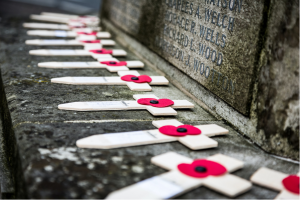
Remembrance Day on the 11th November and Anzac Day on August 25th are both significant events in the Australian calendar.
When the first world war broke out on the 4th August 1914, a large proportion of Australians signed up to serve their King and country. Data from the Australian War Memorial website shows that out of 416,809 Australian soldiers who enlisted for the first world war, more than 60,000 were killed and 156,000 suffered injuries, were taken prisoner, or gassed. This was a huge percentage of the young male population and 10 per cent of the entire Australian population. Something that really stands out as incredibly sad is that in almost every Australian town, no matter how small, you will see a memorial for at least one of its former residents who were killed in action.
One of the most poignant memories in Australian history was the bravery of the ANZACs (Australian and New Zealand Army Corps), where huge losses were sustained by troops at Gallipoli in Turkey. These soldiers were accompanied by allies from Britain and France. They are hailed as great heroes due to their:
‘Bravery, Courage, Endurance and Camaraderie’.
In my early twenties, I took an ESL (English as a second language) job in Canakkale which is known as the gateway to Gallipoli. While living here I met my first group of Australians who were staying in the area for the Anzac Day celebrations. I immediately loved their sense of fun and positivity as they told me the sad stories of their ancestors. Despite huge losses on both sides, the Australians and Turkish still have great respect for each other with different nationalities buying each other beers on the night of the ANZAC celebrations. This is largely to do with the leadership of Mustafa Kemal Ataturk who served in the Turkish army and later became the president, he is still recognised as a great leader. A little while later I took a boat to Anzac cove. The day I visited it was dark and drizzling with rain, the landscape was incredibly harsh with steep hills and uneven footing; hard to navigate even without packs, guns, and ammunition strapped to their backs. It gave me a firsthand realisation of how hard it must have been for those young men who were overwhelmed by Turkish troops so far away from home on unfamiliar territory.
Some facts about the Gallipoli campaign:
- All the Anzac soldiers were volunteers.
- Every year Anzac Day is marked with a Dawn Service as this was the time that the troops arrived at Anzac cove.
- The Anzac soldiers were trained in Egypt rather than in Europe.
- Anzac biscuits were sent from Australia because they contain no egg or dairy and could last the two-month voyage across the sea.
Anzac Animal Heroes:
Simpson and his donkey:
John Simpson Kirkpatrick and his Donkey, who was affectionately named Abdul, Murphy or Duffy received a posthumous mention for their war efforts. The pair were known to have braved gunfire and shrapnel while taking the injured from the battlefield on stretchers. Sadly, the two of them were shot down by machine-gun fire in the course of duty.
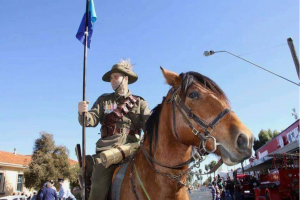
Martin and Leon the Waler (Horse) attending a Remembrance parade in Melbourne. Many thanks to Martin for the picture.
Sandy, the only Australian horse to Return:
Out of 136,000 horses that were sent from Australia in to serve in in WWI, only one made it home. Sandy belonged to Major General Sir William Bridges who was sadly killed in Gallipoli, but unlike his owner, he proved to be extremely lucky and avoided any conflict. Out of the 6,100 horses sent to Gallipoli very few actually got off the boats, as it was decided there was not enough room for them at Anzac Cove. The horses were transported back to Egypt and Sandy remained there until March 1916 when he was moved to France. In 1917 the Minister for Australian Defence Senator George Pierce asked for Sandy to be returned to Australia. Finally, after veterinary assistance and quarantine in England, he arrived back on Australian shores in 1918. This well-travelled horse was able to live out the rest of his life at pasture.
I hope you enjoyed this article and now I am going to leave you with a little taster for next week. Check out these links for ‘Autumnwatch’ which is a project that my brother has been working on recently for BBC Bristol.
I think this may be just what you need to raise your spirits at this difficult time.
View this post on Instagram
Log on next week to find more other exciting projects my brother has worked on during his 20 years with the BBC and to find some more great links.
For all my articles click here or on my name at the top of this page, or head over to my Facebook page ‘Em at Lengro’.