
GRO KIND
Written by a collection of autism experts including our very own Kate Victoria Drohan.

Welcome back to the wonderful GRO KIND!
Our weekly feature focused on helping the communities surrounding Autism with informative and uplifting stories from our GRO PRO team of expert and knowledgeable contributors. This week, we’ll be investigating what it feels like to be autistic and how people have come to understand their condition in later life. If you know someone who is on the spectrum or think you might be yourself even, please take the journey with us to understand more about the world of autism.
As always, this is a huge spectrum to cover, so if you would like to see any information on a specific area, have a question for the GRO PRO team, or feel you have something to share yourself, please do get in touch with us. We would love to hear from you
What’s it Really Like to be Autistic?
By Kate Victoria Drohan, Video reference from The National Autistic Society
From the day my brother was diagnosed with autism and severe learning difficulties at three years old, I’ve been on the quest to understand exactly what it means and what it feels like to be an autistic person. Apart from being told ‘he is different’ and that he had a ‘mental disability’ I wasn’t informed about neurodiversity back in the ’90s (the term was in fact coined by an autistic sociologist in 1998), then again, I was only seven myself when he was diagnosed so perhaps it was difficult to explain. The term Neurodiversity, to be clear, refers to the diversity of human minds, the infinite variation in the neurocognitive within our species. It is in my opinion, that;
“The idea that there is one ‘normal’ type of brain or the ‘right’ style of functioning is no more valid than the idea that there is one ‘normal’ or ‘right’ ethnicity, gender or culture.”
I would spend hours with my bother trying to catch his eye, understand who that person was inside him – there was a light that shone so bright and I knew there was an incredible love there, a very beautiful boy with a wonderful sense of humour. He would hold my face, look into my eyes and he would calm his noises, I would hold my hands out to his hands, and a lovely healing energy would flow from my heart to his. I sensed he knew what he was doing.
Calmness was something Tommy searched for, be it a quiet space, watching T.V or going for a walk in the woods. One day, in a new age shop in town, he walked over to a statue of Buddha, took to his knees, and kissed him on the head. He was only four years old, no speech or language with no conditioning to the world. A pure and peaceful child.
Tommy would usually have his fingers in his ears in busy places and have his eyes closed if there were too many people. As close family, you can feel the uncertainty and frustration but it must be hard for others to understand what exactly what autistic people are experiencing. Here’s a video that I feel really gives you an idea of what it must feel like to be autistic. It’s important to say that this is a huge spectrum, so this simulation will be different from what others who have been diagnosed with autism may experience.
Uplifting & Informative – Top 3 Podcasts to follow
1. The Autism Helper Podcast
The Autism Helper Podcast explores different strategies to improve the lives of individuals with autism.
Frequency 1 episode / week
2. Turn Autism Around
Autism is explored through different angles, with insights into how to turn things around through interviews with top autism experts and stories from those touched personally by autism. This podcast ties all of this together by shifting the way we as professionals and parents look at and treat autism.
Frequency 1 episode / week
Podcast available here.
3. Josh Has Austism
This is a podcast about both having Autism and living with somebody who has Autism. This series brings perspectives of living on and with the Spectrum from Sonya King, her son Josh and various guests. Frequency 2 episodes per day.
Podcast available here.

Asperger syndrome: suddenly everything made sense
By Simon, as featured with The National Autistic Society
BEFORE DIAGNOSIS
I’d always found the world a bit confusing. I never understood why people behave the way they do and why I never really seemed to fit in. I’d done well at school but had found it difficult to relate to people and to make friends.
“I always tried to avoid social occasions but when I couldn’t get out of them I’d end up sitting in a corner, lost in a world of my own.”
I did well at university though and married my fantastic (and extremely patient), wife. After graduating, I got a good job that I enjoyed. But I still couldn’t help feeling that I was an observer on the outside as if there was a big secret that everybody in the world knew but me.
REALISING THAT I WAS ON THE AUTISM SPECTRUM
Then, about two years ago, my wife watched a documentary about Asperger syndrome and instantly recognised that it was describing me. Suddenly everything made sense. I realised why I find some things difficult when they seem to come naturally to everyone else.
“I realised why I don’t always understand what people are saying or feeling. And I realised why I sometimes feel isolated and alone.”
Since then, I’ve tried to learn more about things, such as understanding body language and facial expressions, which had previously eluded me. I’ve read book after book on social interaction and communication, which have helped me to build up my own set of rules for dealing with people. Although this doesn’t yet put me on a par with ‘neurotypicals’ who understand these things automatically, it does make it easier for me to socialise and to develop relationships with friends and colleagues. For instance, I’d always found it difficult to make small talk until I read that the aim of such conversations is merely to pass the time and that it’s OK to drift from topic to topic without reaching any specific conclusions. If only I’d known that it was that simple!
RECOGNISING MY STRENGTHS
I’ve also realised that there are some things that come easily to me that other people find difficult. For example, I’ve found that I’m able to understand complex ideas and then explain them to others and that I can see patterns or trends in numbers and other information that other people can’t. I find it easy to learn foreign languages: I speak French, German, and Russian, and am learning Dutch and Chinese. I’m also fairly bright academically and enjoy learning new things, even though I find it difficult sometimes to concentrate and to understand things that I have read.
Learning about Asperger syndrome has taught me that I have many talents but that I need to nurture these rather than try to pretend that I’m ‘normal’ like everybody else.
ADAPTING MY LIFE TO SUIT MY NEEDS
I’ve made a few changes to my life. I still work in my old job, though now part-time for three days a week. This means that I can focus on solving technical financial and organisational problems for my clients, which I enjoy and am good at, rather than on managing staff.
In my two ‘extra’ days, I’m doing a degree in physics with the Open University, which not only challenges me intellectually but also feeds my passion for learning and knowledge. Since my optician diagnosed me with visual dyslexia, I’m now the proud wearer of a pair of blue-tinted spectacles, which means that I now find it much easier to read and to recall what I’ve read.
In the small amount of spare time that remains, I’m trying to learn more about my Asperger syndrome and to write about my experiences and the many other things that interest me. I do this just for fun at the moment but hope to get some of my articles published one day. Although given the length of time it’s taken me to write this, I’m glad I have another source of income!
These may not sound like momentous changes, but to me, they represent a fundamental shift in what I want to do with my life. I’ve realised that it’s not about doing what everybody else does, but about doing what I want to do. It’s about following my own path, living my own life, and finding my own definition of success.”
I’m still not sure whether having Asperger syndrome is a good or a bad thing, but what I do know is that its part of what makes me who I am. And I’m OK with that.
By Simon
Community, Interesting Links and Contacts
Recommended Websites:
www.ambitiousaboutautism.org.uk
Sensory Product of the week:
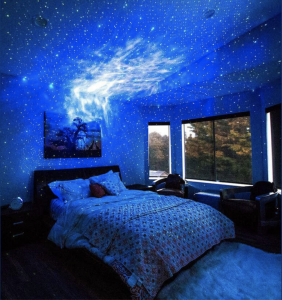
Bring the galaxy indoors! The light instantly projects a field of drifting stars in any room in your house. Simple button controls make it easy to cycle through 10 light colours and effects, adjust brightness, or start/ stop the motion. £54.95 (Reduced from £100)
We hope you enjoyed this issue of GRO KIND! Again, we would like to say a MASSIVE THANK YOU to all of our amazing contributors who have helped create and sculpt this issue.
We would love to hear your feedback. This is your space, your community so if you have any questions for the GRO PRO team to answer in the next issue or would like to share your story with other like-minded people, please do get in touch.
If you’re are an expert in the field and feel there is something you would like to contribute, please get in touch. We would love to hear from you.