

GRO KIND
Written by a collection of autism experts including our very own Kate Victoria Drohan.

We proudly welcome you to another week of GRO KIND!
Our weekly feature focused on helping the communities surrounding Autism with informative and uplifting stories from our GRO PRO team of expert and knowledgeable contributors, some of whom are parents of autist people themselves. This week we have an update from our resident parent, Claire, who, after twenty long weeks, is able to see her son again! We also have some useful information from our experts on changing facilities as well as featuring LGBT and autism links in our useful information section.
LOVE IS LOVE
There’s a lot of support out there in terms of respite and local programs to be involved in, you are not alone. Hopefully GRO KIND will be able to lead you to where you need to go.
As always, this is a huge spectrum to cover, so if you would like to see any information on a specific area, have a question for the GRO PRO team, or feel you have something to share yourself, please do get in touch with us. We would love to hear from you.
And finally, after twenty long weeks of lockdown! – Seeing your autistic children who live in supported accommodation
We talk to Claire Simpson about her and her son’s journeys through lockdown.
What is the set up with your son’s living facility?
Tommy (27) has eventually settled into his supported living house which he shares with three other lads for seven and a half years now. For the twenty years before this transition, I cared for him. It was a huge emotional reach for me when he left home to start a completely new situation but it was the best way forward for Tommy to become more independent and have a more grown-up and socially integrated setting. All the boys are happy and settled in their living situation.
How often do you see him?
To carry on seeing Tommy, we made a routine for him, so he comes home every other weekend. It has been a set pattern for which works for him as part of his scheduled life and we are rigidly consistent in keeping to the arrangement. He did become upset as transitions are hard to deal with for someone with severe learning difficulties, autism, and no verbal communication. Everything was ticking along pretty well, that was until lockdown.
How did lockdown change your routine?
None of us really realised what that would present, especially for parents whose children were already in supported living settings. The weekend we were due to collect him on March 25th (four days after lockdown) we were told we wouldn’t be able to see Tommy for the unforeseeable future due to the new measures. The main one being ‘social distancing’. Of course, Tommy had a meltdown when we didn’t show that weekend and the hardest thing of all is not being able to explain. The boys have no real idea of Covid-19 so very hard for everyone.
How have you all managed?
It did have a huge emotional effect on me. Apart from understanding that we wouldn’t be seeing him for some time to come, it was hard to know how him not seeing us, effectively just vanishing, would affect him. I was worried and pained at how all this would affect him and how he would process it all. Luckily, we have a great relationship with the staff who look after Tommy and we’ve been regularly in contact with them about everyday life. Although it’s been hard over the last few months emotionally, I’m pleased that he has had the care and support through his living situation that I know many people don’t and that I’m grateful for.
When’s the big day?
We have pushed it with the authorities for some contact ideally hoping to get back to his routine and now, after nearly twenty weeks, we have finally won through! We will be seeing him on July 31st – we can’t wait!

Changing Facilities – The ‘loo’ down
Written by our expert Mags Canning, teacher, and parent of a SEN child
Do you ever not go out because of the lack of changing facilities for your child/young person?
In recent years things have been improving, not as quickly as we would like it to but none the less moving in the right direction. Changing Places is a consortium set up in 2005 to make access to toilet facilities available to everyone. The consortium consists of Muscular Dystrophy UK, PAMIS (promoting a more inclusive society), CAE (Centre for Inclusive Environments), and The Scottish Government.
So what are Changing Places facilities and where can I find them?
These facilities are not in place of Accessible Toilets but are provided alongside those already there.
Each facility has an adjustable height changing bench and either a tracking or mobile hoist. No more having to lay on an unhygienic floor to be changed or the carer facing injury.
There is enough space for two carers and most have a screen or curtain to give privacy. Some people only need one carer to change them but two for using a hoist.
There is also a paper roll to put on the bench and a large waste bin for disposing of pads.
Some of the most popular theme parks have them, Alton Towers, Chessington World of Adventures, Lego Land, and Blackpool Tower. Major cities such as London, Brighton, Glasgow, Cardiff and Belfast along with Service Stations other smaller towns all over the UK. Many shops and shopping centres across the UK also have facilities so get out there and spread the word.
So start planning your journey in the UK, you will find all the Changing Places facilities in the link https://changingplaces.uktoiletmap.org/
For further details on Changing Places and their campaign in the UK go to http://www.changing-places.org/
Other countries with Changing Places facilities are:
Australia https://changingplaces.org.au/
Germany https://www.toiletten-fuer-alle.de/
If you live outside the UK, start a campaign to get Changing Places facilities in your country. Everyone deserves dignity and to be treated fairly.
Hope you have a great week
Mags
magscanning@gmail.com

Community, Interesting Links and Contacts
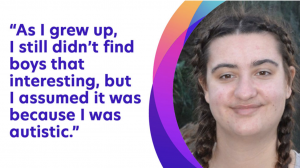
Celebrating LGBT and Autism
We all have multiple identities in life and that’s a fact. We all have a social background, ethnic background and gender. Some people happen to be LGBT, some happen to be autistic and some happen to be both.
Meet Eva, a 24-year-old woman with autism from London
https://www.autism.org.uk/about/stories/eva-gibbs.aspx
Sexual Orientation, Gender Identity and Asperger/Autism link: https://www.aane.org/sexual-orientation-gender-identity-aspergerautism/
LGBT and Neurodiversity link: – https://www.ambitiousaboutautism.org.uk/about-us/media-centre/blog/celebrating-lgbt-and-neurodiversity
Why we need to respect sexual orientation, gender diversity in autism link: https://www.spectrumnews.org/opinion/viewpoint/need-respect-sexual-orientation-gender-diversity-autism/
Facebook Follow (Covid-19 stories that help children with autism) https://www.facebook.com/AtlantaSpectrum/posts/2661599794128632
Autism Speaks is dedicated to promoting solutions, across the spectrum and throughout the life span, for the needs of people with autism and their families. https://www.facebook.com/autismspeaks/
Recommended Websites:
https://www.autism.org.uk/services
https://www.ambitiousaboutautism.org.uk//helplines/main.aspx
http://www.autismforward.org.uk/
Thank you for digesting our sixth issue of GRO KIND! We would like to say a MASSIVE THANK YOU to all of our amazing contributors who have helped create this issue.
We would love to hear your feedback. This is your space, your community so if you have any questions for the GRO PRO team to answer in the next issue or would like to share your story with other like-minded people, please do get in touch.
If you are are an expert in the field and feel there is something you would like to contribute, please get in touch. We would love to hear from you.