

GRO KIND
Written by a collection of autism experts including our very own Kate Victoria Drohan.

We proudly welcome you to another week of GRO KIND!
Our weekly feature focused on helping the communities surrounding Autism with informative and uplifting stories from our GRO PRO team of expert and knowledgeable contributors, some of whom are parents of autist people themselves. This week we look at the Summer Holidays and what that means to families dealing with autism. There’s a lot of support out there in terms of respite and local programs to be involved in, you are not alone. Hopefully GRO KIND will be able to lead you to where you need to go.
As always, this is a huge spectrum to cover, so if you would like to see any information on a specific area, have a question for the GRO PRO team, or feel you have something to share yourself, please do get in touch with us. We would love to hear from you.

Schools Out for Summer – Support and where to find it
Written by our expert Mags Canning, teacher, and parent of a SEN child
For some of you, the next six weeks or so are going to be a continuation of homeschooling but without the support of the teachers. A continuation of being with your child/young person but without the respite that you usually have during a holiday period.
Normal life is gradually resuming, some schools are having summer clubs funded by the government. Your child/young person’s PA may want to start back taking your child for a few hours, especially now they aren’t working in a school where the fear of passing COVID to you and your family has reduced. Leisure centres are starting to reopen so there’s every hope that clubs for your young person will do too. Be proactive, make calls, send emails there will be someone who is able to help or point you in the right direction.
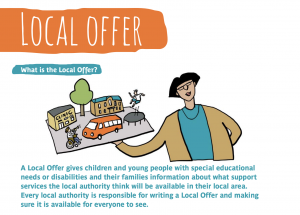
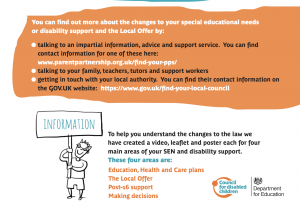
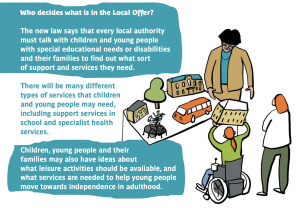
Every parent should have been made aware of the ‘Local Offer’ type it into the search engine along with your area and it will give you information on support and services. Your child/young person’s school or college website should also have the link to the ‘Local Offer’. Click the link below to find out more information about what your council should include in the ‘Local Offer’
Believe it or not, your child/young person’s teachers and support staff will be thinking about you all especially those of you whose children/young people are moving on to further education, day services, or Care homes.
While your child/young person is in school they are more than just students, we have to get to know them, know them as well as you the parents, they become our kids! We are protective of them, we have seen them grow and become more independent, we have seen their personalities develop, we know from when they walk in what sort of day they are going to have, we know when they are unwell, we treat them as if we are their school parents. Look after them how we would like our own children to be cared for.
Your child/young person makes a difference to us all, from each of them we learn something new and that is why we never forget them. They are a shining light and a testimony to the love you have given them and always will.
SEN staff don’t just teach we do really care for each and every child, you aren’t just the parents of the children, and we care for you all too. Please keep in contact with the staff, even if it’s a quick email, as we’d love to know how you and your child/young person are getting on.
Remember you are not alone as GRO KIND will be here for you.
Stay safe and enjoy your summer
Mags
Advice to Parents – How to cope with autistic children during the Summer Holidays
This year’s pandemic posed a great challenge that kept families and vulnerable children away from educational support and services. With the close of the summer term, the lack of routine, homework, social events, and education can be a stressful time for all parents let alone children on the spectrum who find that a lack of routine, especially, can be stressfully overwhelming. Changes in routine can also pose a stressful period for working parents catering for ASD children and this can often result in an interrupted transition to the summer and academic year ahead.
With the latest government guidance on the opening of public places, this summer might be less of a burden for a lot of parents especially as we have managed to draw a list of useful ideas that can help parents plan ahead and work along their children to ensure continued support and learning.
To begin with, it is important that during the summer period parents reinforce a morning, lunchtime, and bedtime routine that their children can follow independently. This can follow home tasks such as washing the dishes, house chores, planting flowers, and why not but feeding the dog. These are tasks that do not require excess planning and supervision.
Although socialising with peers can be difficult, parents can organise picnics with family and friends, garden games that require social interaction, or even having a game of monopoly that requires mathematical skills and turn-taking.
Also, keeping a reward table handy in the house is always a good idea when parents introduce summer homework tasks, reading, or even arts and crafts. Who doesn’t like rewards after all? Liaising with the school for a list of resources you can have is a good start and invest in a colourful reward chart or even better, make one yourself?
Lastly, don’t forget that summer brings playtime and fun activities and with that summer camps and local visits. There are a lot of camps out there that can be ideal for ASD children or zoos and museums that can prove quite therapeutic for the whole family. The National Autistic Society (NAS, https://www.autism.org.uk/) can offer ideas for local visits that suit your family and provide guidance on how best parents can involve ASD children with a list of activities.
Vasiliki Kontou is a BA Education, MA TESOL, NASENCo, and SpLD specialist. Having worked in secondary schools for the last 22 years, Vasiliki is now operating as a British Education consultant and CEO of Tutor Supply nationally with a global perspective.

Education & Autism – Is Mainstream the right option?
Written by Specialist Teacher & Mentor Deb Hannah
When a child goes off to school or nursery for the first time, the parent will naturally feel worried and anxious about letting them go, handing them over into someone else’s care, and knowing it’s the first step towards their child’s eventual independence.
Each transition in education can be emotionally challenging for parent and child for different reasons, High school, College and University (particularly when they leave home to live in halls) all impact the parent and child/young person and are one step closer to their independence. So, if your child has a special need, medical condition, or disability it’s particularly worrying as you wonder if they will be happy and thrive in the new setting and hope that the staff and other pupils will be supportive and understanding.
An Education, Health, and Care plan (EHCP) is a legal document that details a child or young person’s special educational, health, and social care needs. It explains the extra support that should be put in place to meet their needs and enable the child or young person to achieve their life goals through education. The experience for parents does vary as some education settings will engage with and support parents and pupils who are in the process of being diagnosed or are already. However, it is still the case that for some parents it’s a struggle to be taken seriously and their child remains unable to access appropriate support in education, sometimes leading to exclusion or being ostracised by staff and pupils alike, impacting the whole family.
Children and young people with autism face daily challenges and in particular going into new environments. This can be overwhelming, and I have witnessed some autistic children in real distress at school, teaching and support staff don’t always understand the condition enough to support the child in a way that can alleviate the stress, while others have real awareness and can manage children who may be having a ‘meltdown’ in a calm and understanding way. One of the ways we can support children with autism is to help them to understand their own feelings and behaviours, where possible. Helping with the awareness of triggers, that cause uncomfortable feelings, and working on realistic strategies can help them reduce stress in these situations.
Schools aren’t always equipped to support the child completely but getting the child to build up coping strategies and skills can help them to become independent and build resilience Many of the autistic adults I work with were diagnosed in adulthood meaning they spent their childhood navigating life with no real specialist support or understanding from those in education or at home, unconsciously developing their own coping strategies and having no choice but to build resilience.
Young autistic adults, I work with who were diagnosed as children appear better equipped with the self-knowledge of what affects them, but they quite often also have expectations about how others should meet their needs. One recently told me that he struggled after going through the education system and leaving university with an Honours Degree as he was then expected by family and society alike to be independent. He had however been able to build up his self-awareness, social skills, and resilience to a point where he could manage everyday situations and sometimes access support when needed.
So that first step when the child starts school really does give them the opportunities and challenges that help them to develop and grow towards independence in adulthood.


Community, Interesting Links and Contacts
We hope you enjoyed our fourth issue of GRO KIND! Again, we would like to say a MASSIVE THANK YOU to all of our amazing contributors who have helped create and sculpt this issue.
We would love to hear your feedback. This is your space, your community so if you have any questions for the GRO PRO team to answer in the next issue or would like to share your story with other like-minded people, please do get in touch.
If you’re are an expert in the field and feel there is something you would like to contribute, please get in touch. We would love to hear from you.
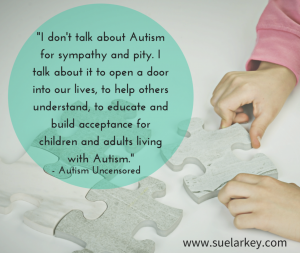
Follow on Facebook – The Contented Child, Child Wellbeing Centre https://www.facebook.com/thecontentedchild/posts/1740233366125024
Online Book of the Week – https://en.calameo.com/read/000777721945cfe5bb9cc?authid=Xu9pcOzU3TQx&fbclid=IwAR2ub9679lyMRSA0mo4YA_luMNkAGoCynRtDSFC8y0kcCvlsvCV0bbLFhDU
Females on the Autism Spectrum
For details of our On-Demand Autism and Girls, The Hidden Gender visit
https://thecontentedchild.co.uk/autism-and-girls/
Autism Speaks is dedicated to promoting solutions, across the spectrum and throughout the life span, for the needs of people with autism and their families. https://www.facebook.com/autismspeaks/
Recommended Websites:
https://www.autism.org.uk/services
https://www.ambitiousaboutautism.org.uk//helplines/main.aspx