Book review – The Girl in the Painted Caravan
Beneath the covers with Jacquie Tyler

Issue 2
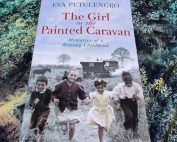
The Girl in the Painted Caravan by Eva Petulengro
Four years ago I was walking along Brighton seafront. I had lost my husband a month before and some friends thought I needed a day out.
As we were walking, I came across Eva Petulengro. I recognised the name ‘Petulengro’ as I’d seen Claire on TV and read her horoscopes. Eva was sitting in for Claire (her daughter) that day at their booth. Now I didn’t know what a Romany gypsy looked like but if I had to guess, Eva
was what I would have imagined one to look like. She was so elegant with her hair scraped back, wearing red lipstick and thick black eyeliner. She reminded me of Bette Davis.
I went into the booth for a 20 minute tarot reading with her. We spent 5 minutes on the reading and the rest of the time we were chatting about her fascinating life. She talked a lot about her husband, Johnnie, and it was so obvious to see that he had been the love of her life. I was so enthralled by her, I knew I had to find out more, so I bought one of her books, and what an amazing book it was.
The Girl in the Painted Caravan is a nostalgic, charming story of a way of life which has now disappeared. Eva was born in her granny’s painted caravan, or vardo, as they were called, in 1939. That particular vardo was called a Reading wagon, the Rolls Royce of caravans.
Eva paints a beautiful picture of the comfort and cosiness of the vardo with its coloured leaded windows and stable door and inside they had lamplights and warm blankets “Granny’s vardo was like a wonderland” says Eva.
Her granny was called Alice Eva and her granddad was lovingly known as ‘Naughty.’ The family travelled round the country and lived off the land. Their way of life was deeply rooted in tradition. The Romany women would cook traditional Romany style recipes that had been in the
families for generations using fresh herbs and produce. They would make their own face packs and hair treatments and if anyone got ill, they would make their own remedies.
The families would travel in the day and sit around the fire, talking and eating in the evenings. After dinner they would sing and play their instruments. Eva remembers, as a child, listening to the radio in the evening and being told wonderful stories at bedtime.
The Romany families always looked after each other. Brothers looked out for their sisters and made sure no one looked at them the wrong way. Eva’s mother, Laura Eva, had a gift for clairvoyance like her mother, Alice. They were taught from birth to express their feelings, keep an open mind and use their instincts and this is how the Romany women learnt and developed their gift for clairvoyance and hand reading. Clients saw them as friends and told them their deepest secrets.
Laura went on to marry a ‘gorger’ (non Romany.) The Romanies had strict moral standards and married once and for life. It was quite usual for them to elope. They were forbidden from marrying someone outside their culture. The differences between Eva’s mother and father became very apparent throughout the book. Eva was let down by her father many times.
Eva was a feisty child. She didn’t go to school but was determined to learn to read and write. She had a thirst for knowledge and taught herself. She loved reading and was nicknamed ‘Bookworm.’ Even when her days were full, she snatched time to study and went on to publish her own magazine many years later.
The fairground world was a very important part of the Romany life. They felt at home working in the fairgrounds. Everyone mucked in and it was a way of catching up with other travelling families and earning some money at the same time. The traveller wives looked and dressed like film stars. They gave readings while the children had fun and enjoyed themselves. After the bustle and excitement of the fair was over, they would pack up their boxes and move on. This is described so well in the book, you can almost see the colours and smell the candy
floss and hot dogs.
It wasn’t all fun and laughter being a Romany gypsy. They faced a lot of discrimination from the police. They were blamed for many things and felt unprotected and persecuted. This probably stemmed from when things changed after the Great Depression and people were
desperate to survive and thought the Romany way of life looked appealing – to be free and independent so they lived the same way but took to begging and stealing. People found it hard to distinguish between Romany gypsies and other gypsies.
Like her mother, Eva also fell in love with someone outside her culture. She lovingly tells the story about how she met Johnnie and how she was terrified of telling her mother about him because he was a Gorger.
The Romany people started seeing a decline in their way of life. The picturesque vardos were replaced with modern aluminium caravans pulled by cars instead of horses. Eva’s father decided they would stop travelling and they moved into a house in Brighton when Eva was 21. She fell in love with Brighton straight away and started up her business and has been there ever since.
I loved this book. Not only was it a heart warming story about the last generation of Romany gypsies and their lost way of life but, for me, it was also the story about the strong Petulengro women. How they worked for their families, were determined to go after what they wanted even when the odds were against them. From Alice Eva, who managed to tame her rebellious husband and didn’t suffer fools gladly to Eva’s 5 aunts and Laura Eva “she only spoke when she had something to say, but her family would always stop what they were doing whenever they saw she was about to speak” and Eva, who became a business woman, celebrity Palmist and Clairvoyant and who read the hands of the Beatles at the Brighton Hippodrome.
There are lots of funny stories in the book and some beautiful photos so you can put faces to the names, which is really lovely. It’s a really good read and I hope you enjoy reading this book as much as I did.
Love
Jacquie x
You may also be interested in….