

Hello and Welcome to…
Em’s World

Sustainability
Australia is a hugely diverse country with an incredibly varied topography. It is comprised of large metropolitan areas, rainforest, desert, alpine and Antarctic regions. For this reason, Australia is affected by a wide variety of environmental issues.
Five environmental issues that affect Australia.
1. Deforestation:
In many areas of Australia, deforestation is responsible for the loss of natural habitats of many birds and animals and the total loss of many tree and plant species. The Koala is currently under threat of extinction due to a combination of deforestation and the effects of the bushfires last year.
2. Soil Erosion:
Soil erosion occurs naturally in many parts of Australia due to harsh climatic factors such as drought, flooding, and strong winds. In some areas, it has been caused by the overgrazing of land and old fashioned ‘slash and burn’ farming techniques. This has a huge effect on productivity and agricultural use. Waterways are affected due to increased salinity and faecal contamination. Less than 2% of the original grasslands remain. In recent years, more has become known about these problems and sustainable cropping and grazing have been introduced, however, in some areas, these practises still remain.
3. Plastics:
The overuse and production of plastics also have a huge impact on our waterways and marine life.
4. Air pollution:
With population growth in Australian cities, there is more demand for transportation and energy in these areas. To help with this problem, the Australian Government provides incentives for people moving to Australia if they are happy to work in rural areas. There is also a lot of debate about coal mining and coal-fired power stations, this debate continues, but slowly greener methods of power are being introduced such as wind farms and solar power which work well with the Australian climate.
5. Introduced species.
Perhaps one of the most prevalent issues concerning sustainability in Australia is introduced species such as cats, rabbits, and foxes, which have had a devastating effect on the land, and native wildlife.
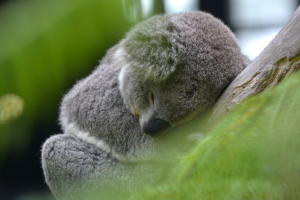
Save our Koalas
Now is not the first time that our native Koala has come close to extinction, as millions of Koalas were killed for their fur in the early 1900s. It was recently discovered by the ‘Australian Koala Foundation’ that between 1888 and 1927, over eight million Koala skins were shipped to the UK and USA. Luckily they had a hero in a man from the USA – Herbert Hoover, the Secretary for Commerce (who later became President). He had spent time in Australia in his youth and saw Koalas as important. In 1927 he passed an order to prohibit the importation of Koala skins to America, which, in turn, saw an end to the Koala fur trade and their numbers grew again. However, in recent years, bushfires and human destruction of native habitat have once again put them at risk.
Koalas feed exclusively on Eucalyptus leaves, however, of the 700 species of Eucalyptus in Australia, the Koala eats only 50 of them. In recent years it has been recorded that 80% of the Koala’s natural habitat has been lost.
Fun Facts about the Koala
- The Koala eats up to a pound of Eucalyptus leaves per day. These are actually toxic, but they have a really long appendix and a specialised stomach to enable them to digest the leaves.
- They are able to store leaves in pouches in their cheeks in order to save them for later.
- They have two opposable thumbs on each front paw to help them climb trees, and two toes on their back paws that are stuck together for grooming.
- They sleep between 18 to 22 hours per day.
- They are not bears, they are actually more closely related to kangaroos as they are marsupials that carry their young in a pouch.
- Baby Koalas stay in their mother’s pouch for 6 months.
- They may look soft and fluffy, but their fur is fairly coarse and is closer in texture to wool than fur and they have VERY sharp teeth and claws.
- The name Koala is said to have come from the Aboriginal word for ‘no drink’, they do however consume small amounts of water.
- Juvenile Koalas smell of Eucalyptus however, as they get older the males become quite pungent due to their mating musk. Their strong Eucalyptus smell acts as a natural insect repellent.
5 things that you can do to help the environment.
1. Get crafty:
With the current situation, many of us have found ourselves spending much more time at home. This enables those who love to craft more time to spend on their projects. In my local area, many clever ladies have turned their hand to making face masks. This is a fantastic idea as over here in Australia in the State of Victoria masks are now mandatory in public places. Although some professions such as doctors and nurses may be required to wear single-use surgical type masks, others can do their bit by purchasing reusable masks from their local Crafting King or Queen. We will not be doing the planet any favours if we all go out and buy single-use masks! The environment is just starting to recover with limits on transport etc, and we do not want to undo this by littering the planet with huge numbers of disposable masks.
Check out this link which contains a free downloadable pattern to make your own mask, even once this situation has eased it may be a good idea to keep your mask handy as they can also help to protect you from air pollution in built-up areas.
For more crafty and planet-saving ideas, check out Gemma Quale’s article in this week’s issue.
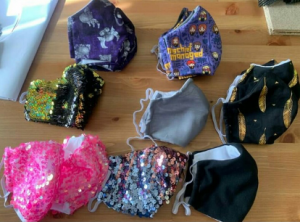
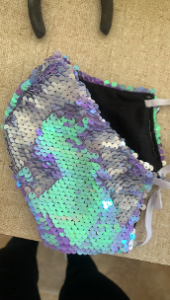
These masks were created by the lovely Jess Bowater.
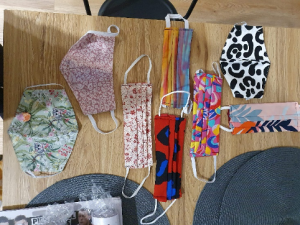
These were created by the equally lovely Steph Davis.
2. Be water-wise:
This is something that I have to be really careful about as my home has no access to mains water. Instead, we rely on rainwater that is collected from the roof and stored in large tanks. Some years are better than others. However, if we get a year where there is very little rain I may find myself on the phone to my local water delivery man quite regularly. I now class David as a good friend as we have shared many laughs and stories while he fills my rainwater tanks!
There are many areas in your home where you can save water usage. For example, I NEVER water my garden. I try to plant things that can survive with only the water they receive from the sky and have found that succulents and native plants work best for me. If you do have a garden that needs watering, consider purchasing a sprinkler system or do your watering before 9am which will give plants enough water for the day. Mulching will also stop water loss due to evaporation.
In the kitchen and laundry, check the water rating of your appliances and watch for leaks and drips. If you are lucky enough to have a dishwasher make sure you always have a full load as this will cut your water usage drastically.
In the bathroom consider buying a timer for your shower, even cutting your shower time by just two minutes can save you water. Look for water-wise showerheads and consider dual flush toilet systems.
3. Recycle:
Always check for signs on the packaging to see if an item can be recycled and if you have any questions check on your local council’s website.
4. Reuse:
So many of our plastics and waste can be reused, so try and think outside the box before you throw things away. Jars can be saved for storage or for your own homemade relish or jam. Spray bottles have many other uses and can also be used to store your homemade cleaning products. The childcare that I work for is always happy to accept clean recycled products for the children to use for crafting and invention.
5. One man’s trash is another man’s treasure:
Think hard before you throw out those old appliances. You can advertise them online on a local buy sell and swap Facebook page or even have a garage sale after cleaning out your house or shed. This will not only help with landfill but you may also earn a bit of extra money at the same time! Half of our house is even recycled, thanks to a fabulous tip from an old magazine called “Burke’s Backyard”! When I became pregnant with my daughter, my husband and I realised that we would definitely need some extra space, so we looked into expanding by adding an extra room and the price was quite high. However, after reading an article in this fantastic magazine, I learned about recycled houses! This is literally the process of moving an old house that is no longer used onto your property. We were able to buy a three-bedroomed house, have it moved onto our property, and stumped all for the price it would cost to have one extra room! This works best with weatherboard (wooden) houses as the cost may be quite high if a house was moved brick by brick!
References and further reading:
I hope you enjoyed this week’s article, log on next week for my interview with the lovely Laura Renwick.
Love Em xoxo